Tuesday marked Day 2 of my journey in the UK, and it started at a much slower, more grounded pace. I had already settled into the Queens Park Hotel, just steps away from Hyde Park. Stepping into the park that morning, I immediately felt a sense of familiarity—it reminded me of Central Park with its scale and energy, but also had the community rhythm of the Atlanta BeltLine on a busy day. Runners, cyclists, families, and dog walkers all moving through the space—it felt alive.
After a 7-hour flight across the Atlantic and a 3-hour layover in Paris, getting outside wasn’t optional—it was necessary. I didn’t have enough time to explore the city itself, and my brief time inside Charles de Gaulle Airport was a humbling reminder that my years of studying French mostly left me with reading ability and a few memorized phrases—not much else.
I’ve never been one to deliver the same presentation twice. Once it gets too rehearsed, it loses its edge. This masterclass wasn’t about The Hip Hop Literacy Laboratory or even Pawn Takes Rook. This was about something bigger—Hip Hop as a global language.
The focus:
How does Hip Hop travel?
How is it reinterpreted beyond the Bronx?
What does it sound like in different parts of the world?
I arrived at ICMP around 6:00 PM for a 7:00 PM session. That’s where I finally met Ryan, who had been coordinating the UK tour behind the scenes. We knocked out a quick interview for their IG, and then I stepped out to grab a bite.
Food in London has been a whole experience in itself—authentic ramen, Indian fish curry, Thai dishes—and then right around the corner, the same familiar staples: McDonald’s, Burger King, Wingstop. The difference? Everything’s in pounds—and once you do the conversion, you realize quickly… you’re paying about 30% more than back home.
The First Masterclass: ICMP London
Inside the session, we shifted the lens outward.
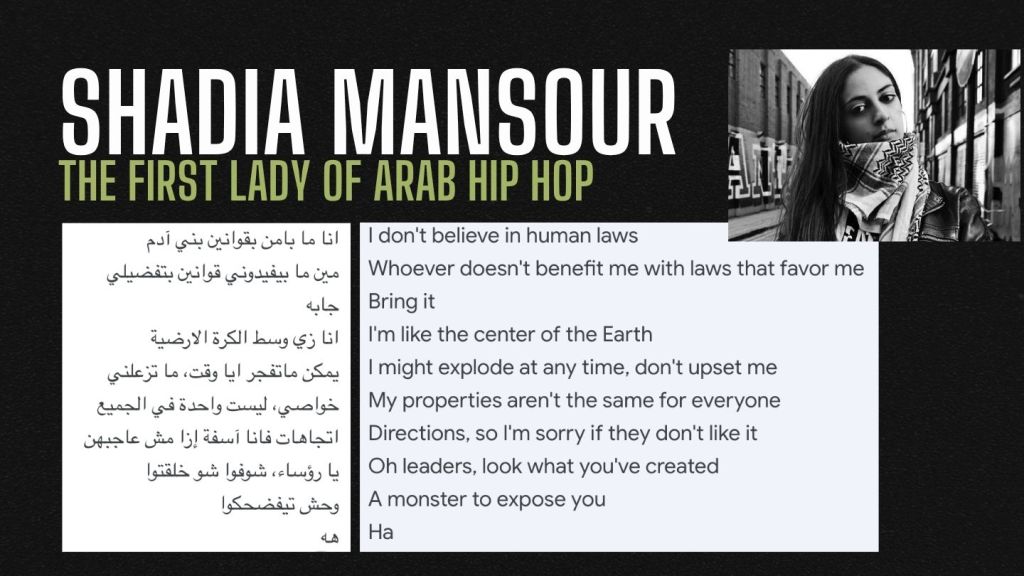
I introduced the room to Shadia Mansour—widely known as the First Lady of Arab Hip Hop. Being UK-based, I expected more familiarity, but many in the room were hearing her for the first time. That moment alone reinforced the importance of this work.
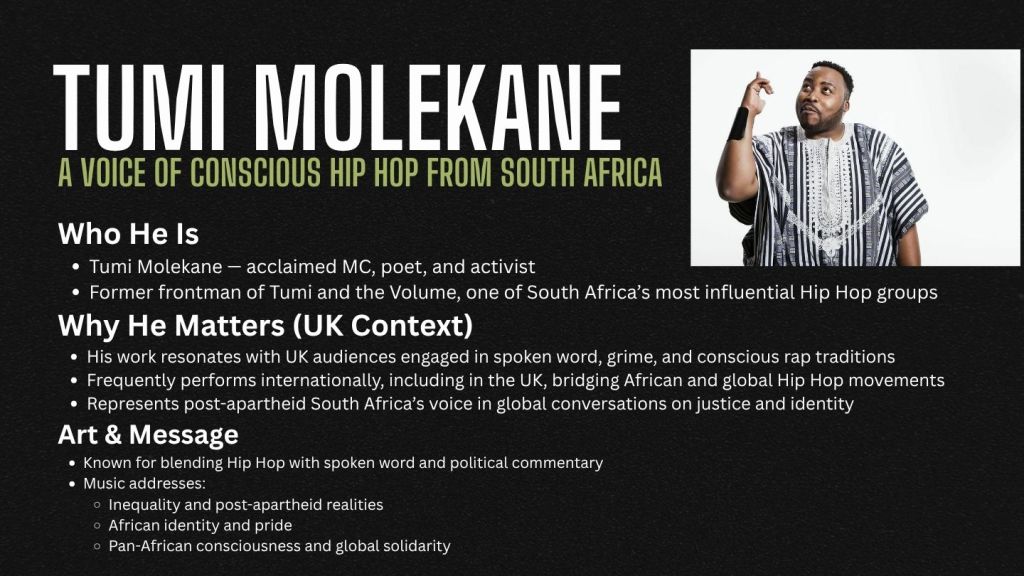
From there, we moved to Tumi Molekane, a South African MC and poet whose work sits at the intersection of African identity and global Hip Hop. We broke down his lyrics—looking closely at how language, aspiration, and resistance show up in his writing.
One verse that stayed with us:
We dey play monopoly
We all dey try acquire some property
A benz and some new friends now I feel uppity
The social ladder I’m climbing so steadily
House on the hills—Aburi or Beverly
I slang my Twi…
That last line opened up a deeper conversation about language—how artists use their native tongue not just to communicate, but to preserve culture and assert identity on a global stage. I explained to the audience that Twi is a widely spoken dialect in Ghana, and that “the hills of Aburi” refers to an affluent, scenic area known for its beauty and elevation. In this way, the lyrics mirror a familiar pattern we see in the United States—artists in the diaspora use Hip Hop to express both their aspirations for a better life and the realities of their current circumstances.
Finally, after the masterclass was done, many of the attendees remained for me to sign copies of my book and to share how powerful the session was for them. I was able to capture some of those reactions. I’m hopeful that the experiences in Leeds and Liverpool will be just as amazing and powerful.
 DEF-ED!
Leave a comment